
Perimenopause and Sleep

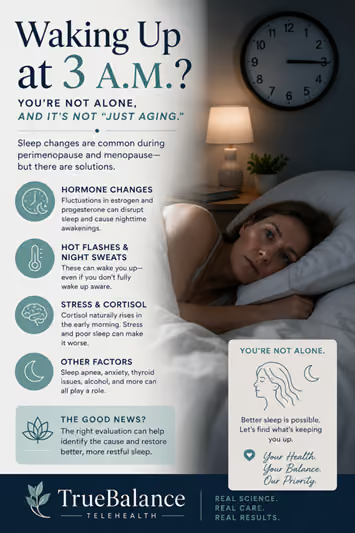
If you've started waking up at 2, 3, or 4 in the morning - and suddenly find yourself wide awake you aren't imagining it.
Sleep problems are common during perimenopause and menopause. And for many women, the problem isn't falling asleep.
It's staying asleep.
You may fall asleep easily, sleep well for several hours, and then suddenly wake up in the middle of the night. Sometimes you're hot or sweaty. Sometimes your mind starts racing.
And sometimes you're simply awake for no obvious reason.
Hormonal changes may be part of the explanation - but they aren't the only possibility.
During perimenopause, estrogen and progesterone levels begin to fluctuate as ovarian function changes.
This transition can affect several systems involved in sleep, including temperature regulation, mood, and the sleep-wake cycle.
Research has found that menopause-related sleep disturbance is often characterized by frequent nighttime awakenings and more time spent awake after initially falling asleep.
That's why some women who never considered themselves poor sleepers suddenly find themselves staring at the ceiling in the middle of the night.
Not exactly.
There isn't good evidence showing that women experience a specific hormonal event at precisely 3:00 a.m.
The more accurate explanation is that middle-of-the-night and early-morning awakenings become more common during the menopause transition.
You may wake at 2:30 one night and 4:00 another.
The important pattern isn't the exact time on the clock. It's repeatedly waking after initially falling asleep and having difficulty returning to sleep.
Cortisol often gets blamed for the classic 3 a.m. awakening, and there is some physiology behind that idea - but it's more complicated than social media sometimes makes it sound.
Cortisol follows a natural 24-hour rhythm. Levels are generally lowest during the first part of the night and begin rising during the second half of the night as your body prepares for morning.
So if you wake up at 3 or 4 a.m., cortisol may already be starting its normal overnight rise.
Stress and chronic insomnia can also affect the body's stress-response system, known as the hypothalamic-pituitary-adrenal (HPA) axis. However, research has not established that an abnormal "cortisol spike" at 3 a.m. is the usual cause of middle-of-the-night awakening.
There's also a chicken-and-egg problem: waking from sleep can itself trigger cortisol release.
The takeaway? Cortisol is part of the sleep-wake system, but repeatedly waking at 3 a.m. shouldn't automatically be diagnosed as a "cortisol problem." Hot flashes, changing reproductive hormones, stress, anxiety, alcohol, sleep apnea, insomnia, and other factors may all contribute.
Night sweats are an obvious reason for disrupted sleep.
But a nighttime hot flash doesn't always mean waking up soaked.
Vasomotor symptoms can include:
These episodes can cause brief awakenings throughout the night.
Interestingly, the relationship isn't always as simple as hot flash → wake up.
Research suggests that hormonal changes, vasomotor symptoms, and sleep disruption interact in complicated ways. In some cases, an awakening may even occur before the hot flash becomes noticeable.
This is where evaluating the bigger picture becomes important.
Waking up during the night doesn't automatically mean you need hormone therapy.
Sleep disruption can have many causes, including:
More than one factor may be happening at the same time.
A woman can be experiencing perimenopausal hormone changes and have sleep apnea, for example.
That's why treating every 3 a.m. awakening as a hormone deficiency can miss the real problem.
Sleep apnea deserves particular attention during and after the menopause transition.
Many people picture someone with sleep apnea as an overweight man who snores loudly. Women don't always fit that stereotype.
Symptoms can include:
If these symptoms are present, evaluating for a sleep disorder may be more important than simply adding another sleep supplement.
For the right patient, it can.
Menopausal hormone therapy is the most effective treatment for bothersome hot flashes and night sweats.
So if vasomotor symptoms are repeatedly disrupting sleep, treating those symptoms can improve sleep as well.
However, hormone therapy isn't a sleeping pill, and it isn't appropriate for every woman with insomnia.
The decision to use hormone therapy should consider your symptoms, medical history, age, time since menopause, personal risk factors, and treatment preferences.
Progesterone often comes up in conversations about menopause and sleep.
Some women report improved sleep while taking oral micronized progesterone, and research suggests it may have sleep-promoting effects in certain women.
But progesterone isn't a universal solution for middle-of-the-night waking, and simply increasing progesterone isn't necessarily the answer.
Sleep problems should still be evaluated in the context of your overall symptoms and health history.
Before reaching for another supplement, it's worth looking at the fundamentals.
Helpful strategies may include:
For chronic insomnia, cognitive behavioral therapy for insomnia (CBT-I) is an evidence-based treatment and can be particularly helpful when waking during the night has become an established pattern.
Sometimes menopause may start the sleep disruption but over time, the brain can essentially learn the pattern of waking and staying awake.
That's where treating both the menopause symptoms and the insomnia itself can be important.
An occasional bad night's sleep is normal.
But it's worth discussing if you:
The goal isn't simply to prescribe something that makes you sleepy.
It's to understand why your sleep changed in the first place.
Waking up at 3 a.m. can absolutely become more common during perimenopause and menopause but there isn't anything magical about 3:00 on the clock.
Hormonal changes, hot flashes and night sweats, mood changes, normal changes in sleep with aging, and underlying sleep disorders can all contribute.
If your sleep suddenly isn't what it used to be, don't automatically assume you're just getting older and don't automatically assume you need hormones either.
A thoughtful evaluation can help determine what's actually disrupting your sleep and which treatment makes the most sense for you.
This is sometimes called sleep-maintenance insomnia. It can become more common during the menopause transition and may be related to vasomotor symptoms, hormonal changes, stress, mood, sleep disorders, or a combination of factors.
Yes. Hot flashes are an important contributor to sleep disturbance, but they don't explain every case. Research suggests reproductive hormone changes and other biological and psychosocial factors may independently contribute to sleep problems during the menopause transition.
It may help when hot flashes or night sweats are contributing to sleep disruption. Systemic hormone therapy is the most effective treatment for menopausal vasomotor symptoms. Whether it's appropriate for you depends on your individual symptoms, health history, and risk factors.
Not necessarily. Before adding supplements, it's helpful to determine what's causing the awakening. Persistent sleep problems may require evaluation for menopause symptoms, insomnia, sleep apnea, restless legs syndrome, mood disorders, medications, or other contributing factors.